Destination: The Americas
Canada
Winnipeg, Manitoba (MB)
Archivist: Rose Vetter
A New Beginning in Winnipeg | St. Joseph's Catholic Church | DVHH-L Postings about Winnipeg
Winnipeg, "Gateway to the West," the capital and largest city of Manitoba, is located at the confluence of the Red River and Assiniboine River, 100 km north of the Minnesota border. It is the largest city closest to the geographical centre of North America. Due to the central prairie location, the climate is harsh, with long, cold winters and short, very warm summers. However, Winnipeg enjoys much sunny weather all year round and is known as the Canadian city that has the most winter sunshine. And that sunshine surely reflects on the people, for Winnipeggers are known to be among the friendliest and most outgoing people in Canada. Even the Manitoba license plates proudly proclaim the friendliness of its citizens! Manitobans are blessed with many scenic lakes, and Winnipeggers spend as much time as possible at their cottages in the summer. One of my fondest memories is sitting by the shore of Lake Winnipeg on clear evenings, watching the stunning display of the dancing Northern Lights. Winnipeg is proud of its contribution to culture and the arts. Many prominent personalities who have made their mark on society were born and raised in Winnipeg. The ethnic diversity of the city is celebrated every August during "Folklorama," the largest cultural festival in North America, featuring forty ethnic cultures. You will also be interested to know that a classic character loved by many children originated in Winnipeg. In 1914 a soldier took a black bear cub named "Winnipeg" to England as his regiment's mascot. Before being shipped to France, he donated the bear to the London Zoo. Author A. A. Milne later wrote stories about a boy and his bear, "Winnie the Pooh"!
For two centuries beginning in 1670, the English Hudson's Bay Company, taking advantage of the lucrative fur trade, had ruled the vast prairie regions and discouraged any settlement. Only one attempt at a settlement of Scots was made during that time at Fort Garry, just outside of Winnipeg, and in order to protect them, one hundred guards were hired, consisting mainly of German mercenaries who had previously been sold by German rulers to England to fight in the American War of Independence. They were given land across the river from the Scottish colony. They asked that their settlement be named St. Boniface in honour of the patron saint of Germany. The name of this suburb of Winnipeg remains to this day without the predominantly French-Canadian population being aware of the German origin of its name!
When it was incorporated as a city in 1873, Winnipeg was still an isolated settlement consisting of shacks, with a population of 3700. However, this was soon to change. Its strategic geographical location made it a natural focus for the western extension of the transcontinental railway. When the Canadian Pacific Railway was completed in 1885, Winnipeg experienced a period of phenomenal growth and prosperity. This growth was fuelled by a flood of immigrants, high wheat prices, plentiful capital and improved farming. The city became the wholesale, administrative and financial centre of the West. This boom ended with the onset of a recession in 1914. The Winnipeg General Strike in 1919 and Great Depression further drove the economy into a severe decline from which the city did not fully recover until World War II.
What Attracted the Danube Swabians?
by Rose VetterWinnipeg has played a major role as a gateway for immigration to western Canada and as a stopover for German settlement in the West. Upon the completion of the railway, the lure of free homesteads and easy credit through the railways gave rise to a mass exodus from Europe of German land-hungry immigrants. More than two thirds of them came from Russia, Austria Hungary and Romania, and it is safe to say that Danube Swabians constituted a major part of this group. The city was able to offer employment to thousands of newcomers. This enabled many to save enough money for the first purchases for their homesteads. From Winnipeg, they were also able to hire themselves out as farmhands and railway workers during the summers, while others worked as tradesmen. Many Banat Swabians who began to arrive in western Canada from the end of the 1890's, like all Catholic immigrants, continued on to the province of Saskatchewan where they established settlements. Had it not been for the recession and the beginning of World War I, many more immigrants would have achieved their dream of becoming landowners. With the onset of the war, immigration of Germans came to an abrupt halt.
With the growing German population in Winnipeg came the establishment of societies. As early as 1892, the Deutsche Vereinigung was founded. Except for a number of years during and after the two world wars, when it was forced to close its doors because of anti-German hostilities, the society still exists today. In 1912 there were two other societies, the Deutsch-Oesterreichisch-Ungarischer Verein and the Deutsch-Ungarischer Verein. I would guess that they too were closed down for the above reasons, but I don't know whether they ever reopened.
As had been the case in the old country, the strongest organizations for the Germans, and the Donauschwaben in particular, were their parishes. Before World War II, there were seventeen German clergy ministering in churches of various denominations in Winnipeg. There were six German parochial schools. St. Joseph’s German Catholic Church was founded in Winnipeg in 1906 and was entrusted to the ministry and leadership of the German missionary order, the Oblates of Mary Immaculate. The German Catholic clergy provided for the formation of a homogenous parish by purchasing a large tract of land in the suburbs and selling it piece by piece to German Catholic immigrants. In this manner they succeeded in creating a closed German Catholic community around St. Joseph’s Church. At the turn of the century, a considerable number of immigrants had also come from the United States and joined the parish. Many had been attracted to Canada by the lower land prices. In 1907 there were 2000 parishioners in St. Joseph’s.
By 1921 more than 60% of the population in Winnipeg’s North End was of German-speaking origin. The German postwar immigration wave from 1923 to 1930 again drew the majority of people from the eastern and southeastern European German settlements. The conditions for ethnic Germans in these regions had deteriorated drastically and the desire to emigrate grew even stronger than before the war. The Banat was now partitioned among Yugoslavia, Romania and Hungary and many villages were cut off from their old markets. Germans from the Yugoslavian Banat and the Vojvodina emigrated in larger numbers now than other ethnic groups - in 1929 almost 1% of the German population in the Vojvodina emigrated.
"At the time we came to Winnipeg in 1950, virtually all of the old-timers of St. Joseph's Parish spoke with a Schwäbish dialect." ~Rose Vetter
"Schönste Lengwitsch," the dialect of the old settlers.
They preferred to go where their relatives and friends had made their fortunes before the war, namely western Canada. Unfortunately, with the 1929 economic collapse, the dreams of many post-war immigrants could not be realized. Many farmhands did not receive their hard-earned wages because the farmer simply did not have the money. Starving and homeless, many unemployed immigrants ended up in Winnipeg where they found shelter primarily in the North End. My uncle and aunt, who had come to Canada in 1926, were among these unfortunate people, scraping for their living as casual workers, depending on relief and standing in soup kitchen lines, or relying on help from the church. Some people became so disillusioned with the conditions they turned Communist. Many of the jobless were deported back to their countries.
Winnipeg was my home for 18 years. Reading about the boom or bust cycle in the times of the pioneers, I can say that we had a much easier time getting established in our new country. Our life was anchored in the community of St. Joseph’s Church, the Kolping Society and the German Society. In 1968 we moved to Vancouver, BC for family reasons, but Winnipeg and the friends we left behind will always be a part of me.
Links
The Bremer Überseeheim (Bremen Overseas Home) where refugees and displaced persons were housed and processed for immigration to Canada after WWII.
Manitoba Census Records Currently, there are 76 census links and genealogy records listed for Manitoba, Canada. You will also find a vast assortment of Manitoba, Canada genealogy resources, links and information.
Archives & Sacramental Records - Genealogy: Searching for Your Catholic Roots
The Archives of the Roman Catholic Archdiocese of Winnipeg genealogy research policy is responsive to requests by family members. It does not have a research room open to the public and genealogy information is provided by mail only.
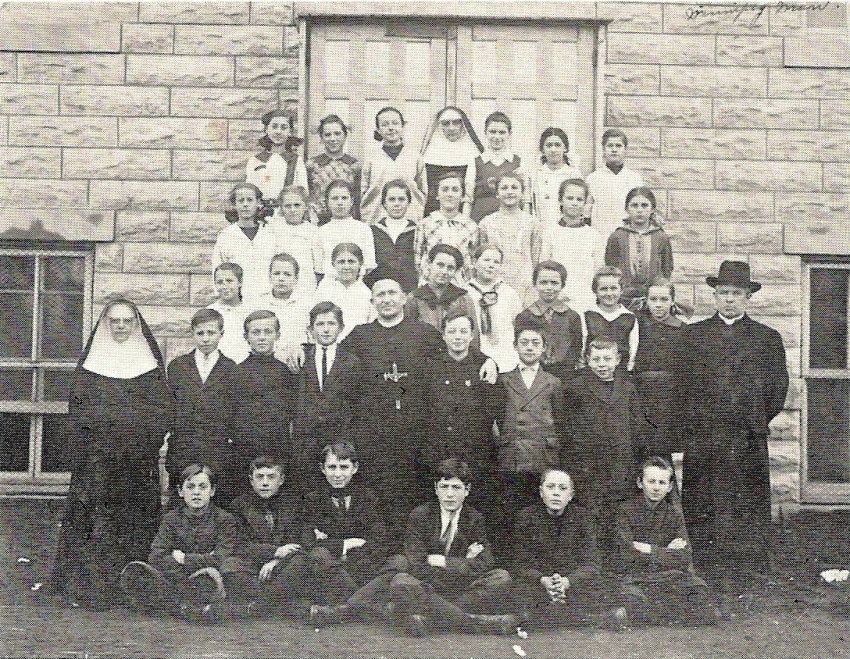
Class Photo
1st ROW: (seated) Martin Kokran, Alfonse Schoenthaler, Mike Kaiser, Joe Plischke, John Hornung, Paul Lang 2nd ROW: Sister Antonia, Frank Cherney, George Hutter, John Gurski, John Tauber, Father Hilland, George Altmayer, Joe Aesch, Father Habets 3rd ROW: Vera Resch, Margaret Ullmann, Gertrude Walter, Elizabeth Wurtak, Eva Schneider, Mary Schroffel, Anne Trager, Mary Runge 4th ROW: Kate Wimmer, Cecilia Yost, Vera Boni, Regina Sitter, Louise Hildebrand, Kate Spehr, Maggie Kolasch, Mary Becker 5th ROW: Elisabeth Altmayer, Caroline Jestadt, Freda Pulkert, Sister Ignatia (Superior), Rose Waks, Rose Stadtherr, Cecilia Herzog
DVHH < Destination: The Americas < Canada < Winnipeg, Manitoba